

A 60-mile fiber activation along Highway 60 gives rural Maricopa communities a long-awaited on-ramp to high-speed internet, education, and economic opportunity.
Imagine a high-speed train running through your town, but there are no stations to get on board — the train just passes by. Now imagine that train carries fiber internet, and you live in an area with few options for reliable connectivity.
That’s the reality in some rural areas like northwest Maricopa County, where fiber exists underground but communities have no way to tap into it. And it’s the reason Sun Corridor Network (SCN) recently completed a project to unlock that capacity.
In partnership with Zayo, and with funding from the Maricopa County Broadband Initiative (MCBI), SCN activated more than 60 miles of existing fiber along Highway 60. Now there are two new access points — like stations on a rail line — where local networks can connect, allowing rural communities to tap into faster service.
A route that passed people by
Most long-haul fiber lines connect major population centers in order to serve the most people at once. In this case, the fiber cut straight from Phoenix to Las Vegas along Highway 60 and 93, bypassing smaller communities in between.
But there are still people, schools, governments, nonprofits, and clinics along that path — many relying on limited service, with only a fraction of the speed the main line carries.
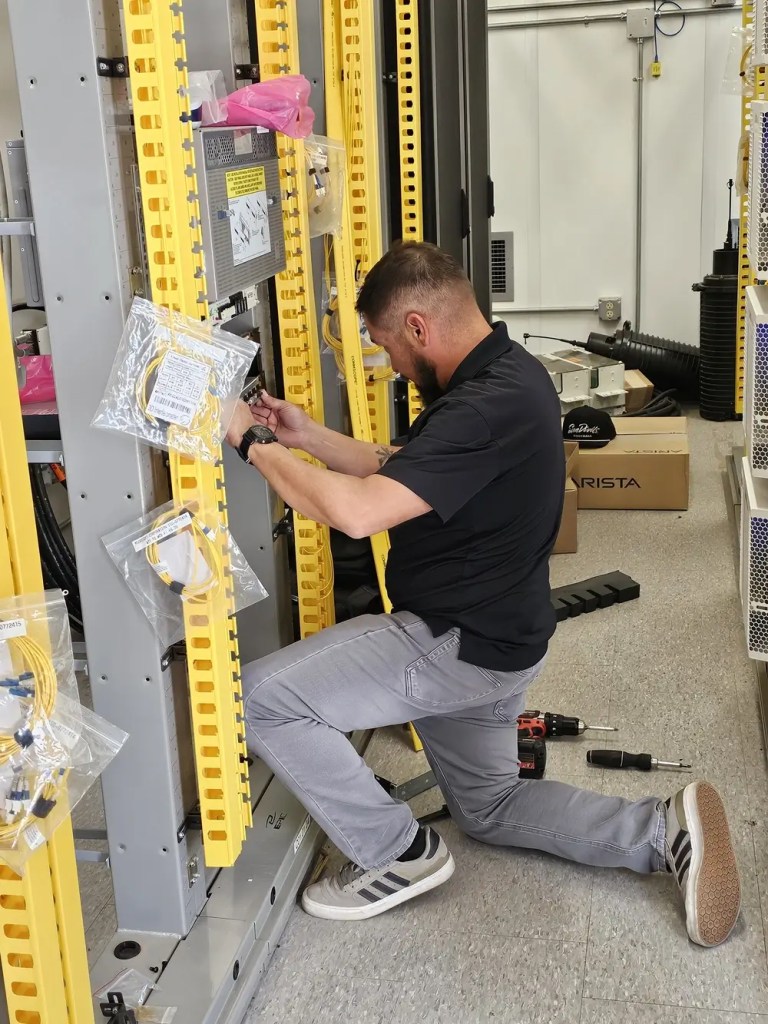
Recognizing the need, SCN reached out to Zayo, which allowed them to design and install two new “on-ramps” to the route. Under the direction of SCN technical director Rolando Alvarez, the team accessed Zayo’s regeneration shelters to do so.
These are secure enclosures placed roughly every 50 miles that boost the fiber signal for long-distance travel. Normally they are closed off, simply keeping the signal going from point A to point B. But SCN’s team “interrupted that light,” as SCN’s Jim Bascom put it, and installed new electronics to allow traffic to get on and off the network.
“Sun Corridor is enabling that,” he said. “It’s an indirect relationship – meaning SCN doesn’t directly provide the end-user service [to individual residents], but they connect the middle so that providers are enabled to step in.”
A multi-partner approach
The project was supported by multiple players: MCBI, an initiative of Arizona State University’s Enterprise Technology, provided the funding framework through a $34.6 million county investment, while Zayo supplied the long-haul fiber and access to its equipment shelters, and SCN handled the physical and electronic upgrades.
Each organization brought a distinct role, and the result was an efficient and collaborative way to expand connectivity.
“We accomplish more when multiple partners bring their strengths to the table,” says Derek Masseth, executive director of SCN. “By coming together, we created something that hadn’t existed before. Local, technical, and community-focused solutions like this are exactly how we close access gaps in Arizona.”
“We’re proud to play a part in transforming connectivity for rural Arizona,” said Jason Taylor, VP of Global Public Sector at Zayo. “Connectivity is the cornerstone of modern life, and our work with Sun Corridor Networks and Maricopa County is about empowering local communities with better education, improved healthcare, and broader economic opportunity. By lighting up fiber along Highway 60, we’re bridging the digital divide and helping rural Maricopa County take full advantage of today’s digital tools and tomorrow’s possibilities.”

Building momentum for a connected future
Over 11% of Maricopa County’s population lives below the poverty line, and in many rural areas, affordable broadband is still hard to come by. The infrastructure now activated provides a cost-efficient upgrade — estimated at $2.8 million in fiber and electronics — and has the potential to serve thousands of residents and community anchor institutions for years to come.
For residents, that means better options. Partner providers are expected to finalize agreements in the coming months, with speeds tripling or quadrupling compared to what’s currently available.
But for schools, government entities and other community anchor institutions, the upgrade means access to SCN’s nonprofit research and education network. This amounts to not only drastically improved speeds, but additional security and affordability benefits that commercial providers lack.
Bascom explains it this way: “If you’re a school in Surprise, Arizona, and you send a message to a school in Glendale, Arizona using a commercial internet service provider, it probably goes to Denver and back to get the message there. That’s just how they send internet traffic. But we don’t do that. We send it from Surprise to Glendale. And there are reasons why this matters, like security, latency, and speed.”
Student workers at ASU have begun reaching out to help these schools, nonprofits, municipalities, and local ISPs tap into this new resource. In the meantime, the newly activated Highway 60 corridor paves the way for future work in Wittmann, Wickenburg, and continued expansions along I-17 and I-40.
This project shows how Maricopa County’s investment in broadband is fueling real infrastructure improvements. As more partners connect and more routes come online, the Highway 60 activation stands as a working example of how local leadership and long-haul fiber can come together to solve long-standing problems in rural connectivity.
“Our investment in rural fiber is an investment in people,” said Taylor. “When we connect families, schools, and businesses to high-speed internet, we open new corridors of innovation and prosperity that benefit the entire region. Faster, more reliable internet service means more opportunities for students, entrepreneurs, and healthcare providers. This is what progress looks like.”
The Maricopa County Board of Supervisors voted to provide Arizona State University and its collaborators $34.6 million of US federal funding to advance broadband, community support, equipment and training across Maricopa County from 2022-2026. This collective work is known as the Maricopa County Broadband Initiative. Visit the AZ-1 portal for insights into the current state of digital access and inclusion – developed as a shared resource through MCBI. Learn more about each collaborator: ASU; Sun Corridor Network; and the Institute for Digital Inclusion Acceleration (IDIA).