Through $5M grant, SCN hires biologist and wireless network engineer Renée Brown to advance field science
Studying the natural world in remote places has long been challenging. For years, scientists had to trek into hard-to-reach areas and hope they were in the right place at the right time to collect data by hand. But today, sensors can do that work around the clock — capturing storms, floods, and other events in real time and, thanks to broadband connections, streaming the data across miles of rugged terrain.
These sensors, deployed across the remote Southwest, measure everything from soil moisture to temperature shifts and give scientists a continuous view of how ecosystems are changing. But it all depends on one thing: reliable internet connections in some of the most difficult places to reach.
This is the kind of work Renée Brown has built her career around: bringing networks to the wild. With decades of networking expertise and a PhD in biology, she has carved out a rare niche at the intersection of technology and science. And now, through the support of the $5 million WildWEST (Wild-area-networks Wireless Enabling Science Team) grant, she has joined Sun Corridor Network (SCN) as a research engineer of field networks.
WildWEST: Expanding science in hard-to-reach places
WildWEST is a collaboration among Research and Education Networks (RENs) in the Southwest states of Arizona, Nevada, and Utah. Funded by the National Science Foundation, the project helps scientists overcome one of their biggest hurdles: connecting equipment and sensors to the internet in locations far from cell towers — or even roads.
For SCN, the grant is not only an opportunity to expand broadband for science, but it’s also what made it possible to bring Brown on board — a rare scientist fluent in both networking and ecology, as well as the needs of field researchers.
“Scientists are very embedded in their research… and they typically don’t know very much about ‘How do I connect my site to the internet?’ or ‘If something goes wrong, how do I fix it?’” Brown said. “And so the aim of the WildWEST grant is to build a community of practice around improving these skills for researchers and providing that support. We’re connecting with researchers, figuring out what their needs are, and helping them get access to that.”
That dual impact — advancing broadband for science while also strengthening the human expertise behind it — is what makes the grant and new hire so meaningful for SCN.
“It’s a big deal. We received a grant to advance science, and through it we were able to hire a scientist to help us do exactly that,” said Derek Masseth, executive director of SCN. “We want to leverage Renée’s experience and the fact that she’s now on our team to build inroads into biology — and particularly into the Global Futures Laboratory at ASU — so we can better understand how to support the university’s research mission.”
From IT to ecosystem ecology
Brown’s unusual career path makes her uniquely suited to the role. She began as a self-taught Unix system administrator in high school and later managed servers for the University of New Mexico (UNM), supporting a biology team at the Sevilleta National Wildlife Refuge. What began as IT support turned into helping the group build a wireless network across the refuge — one she co-ran for nearly 20 years.
She continued to develop her technical skills through education, but over time, the work pulled her deeper into the science itself.
“I was kind of pursuing a computer science degree on the side, and wasn’t loving it, and so I decided to switch my degree to biology,” she said. “I decided, you know, I didn’t want to be a technician for the rest of my life. I wanted to be a PI [Principal Investigator].”
She went on to earn her PhD in biology, specializing in ecosystem ecology, and today continues to lead and co-lead long-term research experiments in the Southwest. She also maintains a research appointment at UNM and a fellowship with ASU’s Global Futures Laboratory.
Throughout this work, countless projects have shown her firsthand the value of connectivity.
“A lot of times when I have my researcher hat on, we’re working in really remote places, and they can be many hours away from anything,” she says. “And then in the higher elevations in the winter time, sometimes the only way you can get access to these sites is by skiing in or sometimes not at all.”

Her work has taken her throughout the desert Southwest, where she researches changes in precipitation and the effects of wildfire on fish habitats, and even as far as Antarctica. Across it all, sensors allow her to continually observe patterns on the ground as they unfold, rather than piecing together evidence after the fact, which greatly accelerates research.
“In Antarctica, for example, we can only get there twelve weeks out of the year, and so having real-time access to the data is super important,” she says. “It allows us to be able to see what’s going on in these systems when humans aren’t there.”
Hat Ranch: A proving ground
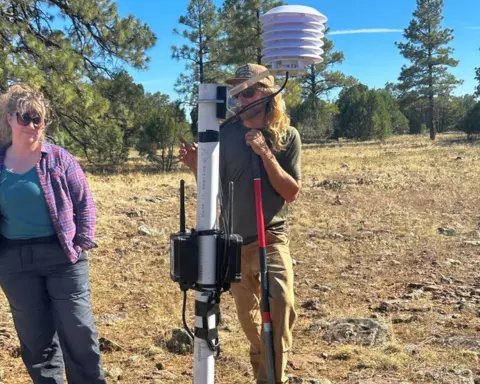
One of Brown’s first projects will be at Hat Ranch, a Northern Arizona University field station that currently relies on satellite internet. Because the site sits within view of a mountaintop equipped with broadband infrastructure, SCN will be able to upgrade the equipment’s connectivity. For local researchers, that upgrade will benefit their ability to obtain real-time data 24/7.
Hat Ranch is also where SCN has been piloting new training approaches, such as a “summer camp” for professionals, which they hosted in August. There, participants practiced networking skills in the woods through a hands-on “learn one, do one, teach one” model. Although Brown wasn’t yet on board, she is excited for the potential to lead similar training, particularly sensor network workshops.
“I actually have a lot of experience running sensor network training workshops, so I did that for several years, and it was probably one of the most rewarding experiences of my career,” she said.

Agriculture and beyond
Beyond field stations, Brown is eager to support SCN’s agricultural work. In Yuma County, SCN has been deploying private 5G networks to power drones, smart irrigation, and other AgTech tools. Brown will help scientists and farmers alike learn to make the most of these emerging systems.
She summed it up simply: “I’m very passionate about integrating technology and science, and I’m super excited to be a part of this and see what we can accomplish over the next five years and beyond.”